
For wholesalers and distributors, the best approach to sourcing wholesale trapper hats is to select styles that match customer demand, verify materials and construction, and work with a manufacturer that can deliver consistent quality at competitive landed costs. SUMKCAPS recommends prioritizing product suitability, approved samples, reliable lead times, and inventory control rather than choosing suppliers solely on unit price.
Whether you supply outdoor retailers, hunting brands, apparel stores, or promotional product companies, a well-planned trapper hat assortment can help you meet seasonal demand while protecting profit margins.
Which Trapper Hat Styles Should Wholesalers Stock?
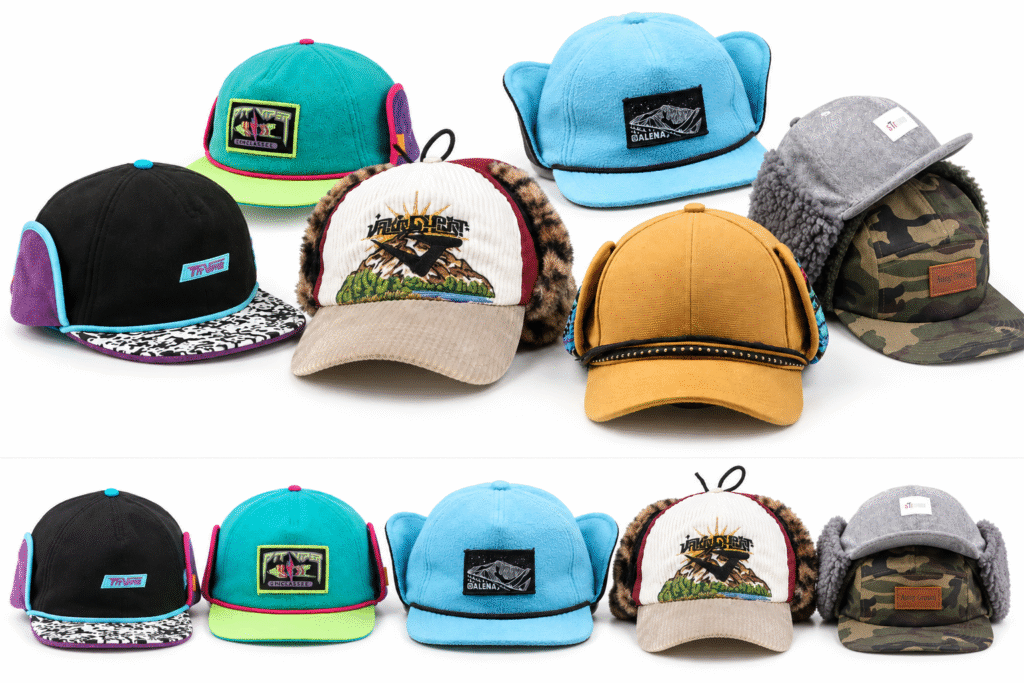
Wholesalers should select trapper hat styles based on their customers’ sales channels, climate, and product positioning. Classic fur-lined designs, earflap baseball caps, and lightweight outdoor styles serve different markets, so a balanced assortment is generally more useful than purchasing every available design.
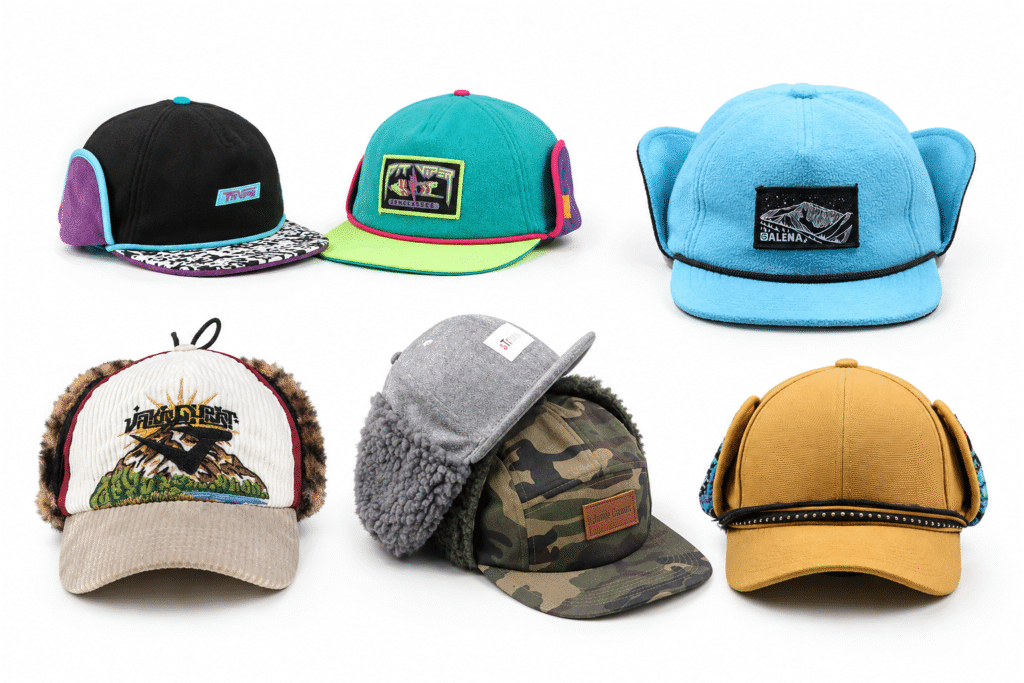
Classic Trapper Hats
Classic trapper hats feature a rounded crown, insulated lining, and earflaps that can cover the ears and parts of the face.
- Target buyers: Winter apparel retailers, outdoor equipment distributors, and cold-weather accessory wholesalers.
- Aanbevolen bronnen: Polyester or nylon shells with fleece, sherpa, or faux fur lining.
- Procurement considerations: Check earflap coverage, lining attachment, stitching consistency, and adjustable fasteners.
Earflap Baseball Caps and Hunting Caps
These designs combine a baseball cap brim with foldable or extended earflaps.
- Target buyers: Hunting equipment distributors, outdoor lifestyle brands, and casual headwear retailers.
- Aanbevolen bronnen: Cotton twill, corduroy, polyester, or camouflage fabrics.
- Procurement considerations: Confirm brim shape, crown fit, earflap dimensions, and closure construction.
Not every hunting cap is a trapper hat. Buyers should specify the exact crown, brim, and earflap construction when requesting quotations.
Fashion and Private Label Trapper Hats
Fashion-oriented designs often use corduroy, contrasting panels, decorative embroidery, or faux fur accents.
- Target buyers: Streetwear brands, fashion accessory distributors, and private label retailers.
- Customization options: Flat embroidery, woven labels, leather patches, and branded packaging.
- Procurement considerations: Verify logo placement, material consistency, and color accuracy before production.
| Trapper Hat Style | Primary Market | Key Buying Consideration |
|---|---|---|
| Classic fur-lined | Winter apparel | Insulation and comfort |
| Earflap baseball cap | Hunting and outdoor | Fit and ear coverage |
| Nylon/polyester trapper | Performance outdoor | Weersbestendigheid |
| Corduroy trapper | Fashion and lifestyle | Appearance and texture |
| Private label trapper | Branded retail | Customization consistency |
Buyers can explore the Trapperhoed Groothandel collection at SUMKCAPS to compare styles before developing a wholesale assortment.
What Materials and Features Matter Most in Wholesale Trapper Hats?
The best materials depend on the target market, expected weather conditions, and retail price positioning. For bulk buyers, shell durability, lining comfort, insulation, and construction consistency are more important than choosing a material based on appearance alone.
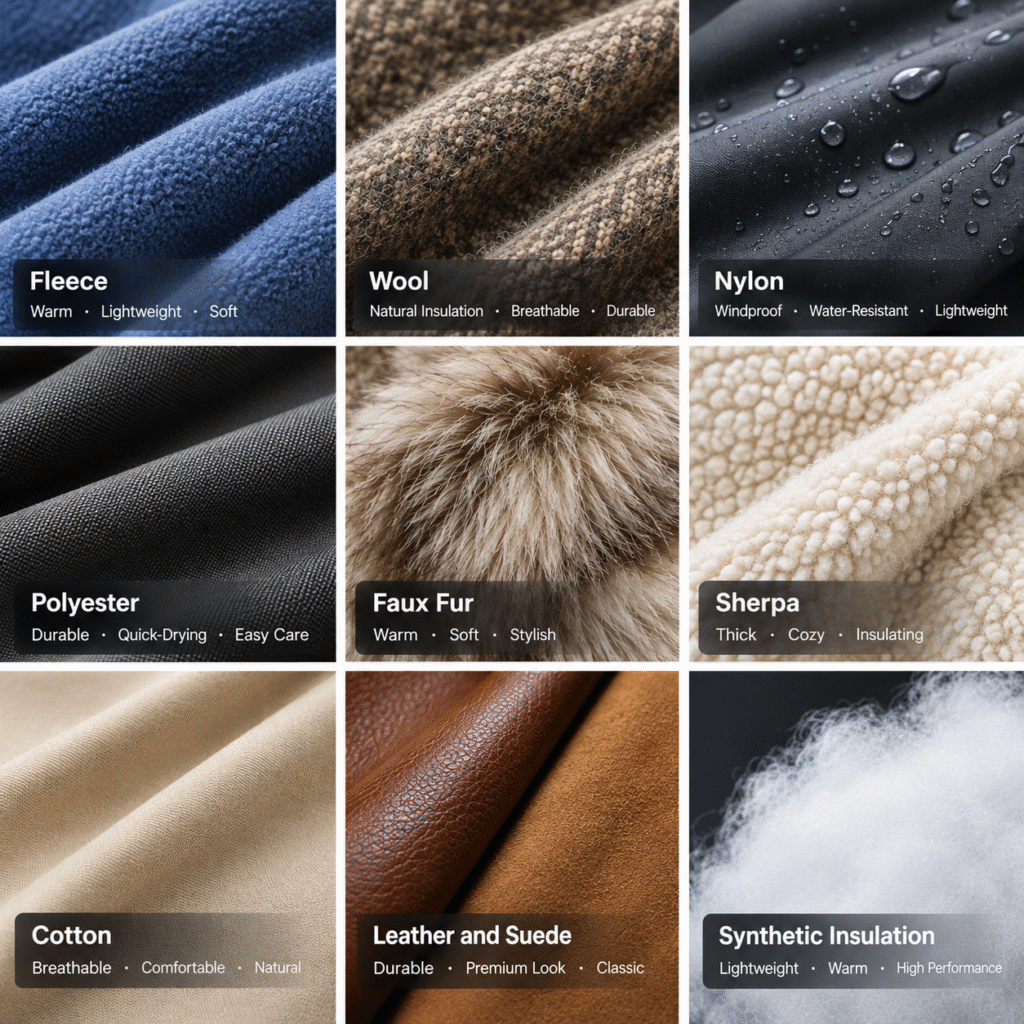
Outer Shell Materials
Cotton and corduroy: Suitable for casual and fashion-oriented collections. Cotton twill offers a familiar appearance, while corduroy provides a textured, seasonal look.
Nylon and polyester: Practical options for lightweight outdoor designs. Depending on fabric construction and finishing, they may offer wind resistance or water repellency.
Buyers should not assume that every nylon or polyester hat is waterproof. Water resistance depends on coatings, seams, and the finished product’s construction.
Lining Materials: Fleece vs. Faux Fur
Fleece is generally lightweight, soft, and relatively easy to maintain. Faux fur offers a fuller winter appearance and can provide additional insulation depending on pile density and construction.
| Materiaal | Main Advantage | Procurement Check |
|---|---|---|
| Katoenen keperstof | Versatile casual appearance | Fabric weight and shrinkage |
| Corduroy | Distinctive texture | Rib consistency |
| Nylon | Lichtgewicht constructie | Coating and water resistance |
| Polyester | Versatility and durability | Fabric specifications |
| Fleece | Soft, lightweight lining | Pilling and attachment |
| Kunstbont | Plush appearance | Shedding and pile consistency |
| Sherpa | Textured thermal lining | Thickness and durability |
Essential Construction Features
For winter markets, buyers should evaluate:
- Earflap coverage: Check whether the earflaps provide the intended ear and cheek protection.
- Adjustable closures: Verify buckle, strap, or fastening strength.
- Lining attachment: Inspect seams and potential separation points.
- Sizing: Confirm finished measurements and allowable tolerances.
- Insulation: Request construction details rather than relying on unverified temperature ratings.
SUMKCAPS supports material selection and construction customization based on the buyer’s intended application and approved specifications.
How Much Do Wholesale Trapper Hats Cost?
Wholesale trapper hat prices depend on order quantity, materials, design complexity, branding, and packaging requirements. Buyers should compare quotations using identical specifications and calculate the total landed cost before selecting a supplier.
Factors That Affect Wholesale Pricing
Five major factors influence manufacturing costs:
- Order quantity: Larger production runs may distribute setup costs across more units.
- Shell and lining: Fabric type, insulation, and faux fur construction affect material consumption.
- Customization: Embroidery size, stitch count, patches, and private labels add processing costs.
- Bouw: Multiple panels, earflap attachments, and specialized closures affect labor requirements.
- Packaging and logistics: Individual packaging, cartons, shipping terms, and destination influence total cost.
What Is the MOQ for Wholesale Trapper Hats?
At SUMKCAPS, the standard MOQ is 200 stuks per kleur per ontwerp.
For example, a distributor ordering one design in three colors should plan for a minimum of 600 pieces, assuming each color meets the standard MOQ.
For smaller distributors, starting with two or three commercially relevant colors may be more manageable than launching an extensive collection.
How to Calculate Landed Cost
The purchase price alone does not determine profitability.
Landed Cost per Unit = (Product Cost + Freight + Duties + Other Import Costs) ÷ Total Units
For example, consider a hypothetical order of 1,000 hats:
| Cost Component | Example Amount |
|---|---|
| Product cost | $5,000 |
| Freight | $800 |
| Duties and other import costs | $700 |
| Total landed cost | $6,500 |
| Landed cost per hat | $6.50 |
These figures are illustrative, not a SUMKCAPS quotation.
If the distributor sells each hat for $10, the gross margin before operating expenses is 35%.
When requesting a quotation, provide the design, material specifications, logo requirements, quantities per color, packaging instructions, and delivery destination.
How Do You Choose a Reliable Trapper Hat Manufacturer?
A reliable manufacturer should demonstrate production capability, sample development support, consistent quality control, and realistic delivery commitments. Wholesale buyers should verify these factors before committing to large seasonal orders.
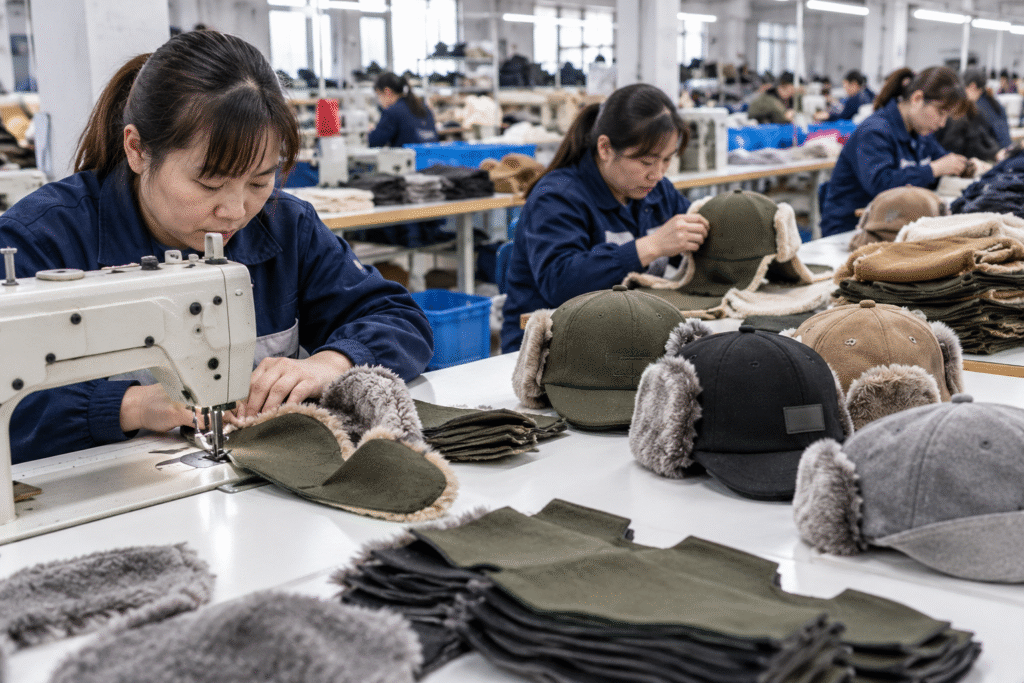
Evaluate Manufacturing Capabilities
SUMKCAPS is a headwear brand under Baoding Shenxiu Trading Co., Ltd., specializing in wholesale and custom headwear manufacturing.
Its manufacturing capabilities include:
- Approximately 6,000 square meters of production facilities.
- More than 120 skilled workers.
- Annual production capacity exceeding 2.6 million headwear units across its product range.
- More than 10 years of international trade and export experience.
The annual capacity refers to overall headwear production, not trapper hats exclusively.
Review Samples Before Bulk Production
Samples allow buyers to verify materials, dimensions, fit, logo placement, and workmanship before approving mass production.
At SUMKCAPS:
- Sample fee: US$50 per piece.
- Sample shipping: US$35.
- Typical sampling time: 7-9 werkdagen.
Buyers should confirm whether modifications require additional samples or development charges.
Verify Quality Control
A wholesale trapper hat inspection should cover:
- Fabric color and texture consistency.
- Crown shape and finished dimensions.
- Earflap symmetry and lining attachment.
- Stitching, embroidery, and patch placement.
- Closure functionality.
- Packaging and quantity accuracy.
For repeat orders, use an approved production sample and written specifications as the inspection reference.
Buyers may also review relevant factory audits and certifications, verifying their validity and scope rather than assuming that certification alone guarantees product quality.
How Long Does Wholesale Trapper Hat Production Take?
Production lead time depends on order volume, material availability, customization complexity, and factory scheduling. Distributors should account for sampling, approval, manufacturing, shipping, and customs clearance when planning winter collections.
SUMKCAPS Production Timeline
| Order Stage | Estimated Time |
|---|---|
| Monsterontwikkeling | 7-9 werkdagen |
| Production under 5,000 pieces | 25–35 working days |
| Production over 5,000 pieces | Approximately 35–45 working days |
| Internationale verzending | Depends on destination and shipping method |
These are estimated production periods. Actual schedules should be confirmed before ordering.
When Should Distributors Place Winter Orders?
For seasonal products, buyers should work backward from the intended retail launch date.
A practical purchasing schedule includes:
- Finalizing styles and target quantities.
- Requesting samples and approving specifications.
- Confirming purchase orders and production schedules.
- Allowing sufficient manufacturing time.
- Adding freight, customs, and warehouse receiving buffers.
For example, a distributor planning a November retail launch should not assume that placing an order in October provides sufficient time for production and ocean freight.
Early planning reduces the risk of missed seasonal sales opportunities.
How Can Wholesalers Reduce Inventory and Sourcing Risks?
The most effective risk-control strategy is to limit unnecessary SKU complexity, approve samples before production, and establish measurable quality and delivery requirements. These practices help distributors avoid excess inventory and unexpected procurement costs.
Control Seasonal Inventory Exposure
Trapper hats are strongly associated with cold-weather demand, making inventory planning particularly important.
For an initial assortment, distributors can prioritize a limited selection of core designs and colors before expanding into more specialized products.
With SUMKCAPS’s MOQ of 200 pieces per color per design, ordering five colors instead of two increases the minimum quantity for one design from 400 to 1,000 pieces.
Reduce Quality and Specification Risks
Before production, confirm:
- Approved material samples.
- Finished measurements and tolerances.
- Logo artwork and placement.
- Color references.
- Packaging requirements.
- Inspection criteria and defect handling.
A documented specification sheet helps reduce misunderstandings between purchasing teams and manufacturers.
Plan for Repeat Orders
Repeatability matters for distributors supplying established retail accounts.
Maintain records of approved materials, construction details, labels, and packaging specifications. Confirm material availability and production scheduling before promising replenishment dates to customers.
Why Choose SUMKCAPS for Trapper Hat Wholesale?
SUMKCAPS supports wholesalers and distributors with factory-direct headwear manufacturing, OEM/ODM customization, sample development, and international order coordination.
Buyers can develop wholesale trapper hat collections using different fabrics, linings, colors, embroidery techniques, patches, labels, and packaging options.
With a standard MOQ of 200 pieces per color per design, SUMKCAPS supports both focused wholesale assortments and larger customized orders.
Distributors seeking private label development can also explore Custom Trapper Hats for additional customization options.
Ready to source wholesale trapper hats?
Browse the SUMKCAPS Trapperhoed Groothandel collection and request a quotation based on your required styles, quantities, materials, and delivery destination.
FAQ About Trapper Hat Wholesale
A: Trapper hats typically feature insulated earflaps for cold-weather protection. Hunting caps cover a broader category, including baseball-style caps, camouflage hats, and insulated earflap designs.
A: SUMKCAPS has a standard MOQ of 200 pieces per color per design. Total order quantity depends on the number of selected designs and colors.
A: Yes. SUMKCAPS supports custom embroidery, woven labels, leather patches, and other branding options based on product construction and design requirements.
A: Fleece is generally lightweight and comfortable, while faux fur offers a plush appearance. The best option depends on the intended climate, design, and retail positioning.
A: Yes. SUMKCAPS supports multiple colors, provided each color and design meets the standard MOQ of 200 pieces.
A: Yes. SUMKCAPS offers samples at US$50 per piece plus US$35 shipping, with a typical sampling period of 7–9 working days.


