
For apparel, outdoor, and private label brands, the best approach to sourcing custom trapper hats is to prioritize functional design, appropriate shell and lining materials, reliable manufacturing, and consistent quality over the lowest unit price. At SUMKCAPS, we recommend selecting hat specifications based on your target market, confirming samples before bulk production, and working with a manufacturer that supports OEM and ODM customization. With a minimum order quantity of 200 pieces per color per design, brands can develop customized winter headwear collections while maintaining control over product quality, branding, and production requirements.
Why Choose Custom Trapper Hats for Your Brand?
Custom trapper hats offer brands a combination of cold-weather functionality, distinctive winter styling, and extensive customization opportunities. Their earflap construction, insulated linings, and adjustable fastening options make them suitable for various retail and professional markets.
1. Outdoor and Hunting Gear Brands
For outdoor and hunting brands, functional performance should determine the product design.
- Ear coverage: Extended earflaps help protect the ears and sides of the head from cold wind.
- Outer materials: Nylon and polyester fabrics can be selected for durability, wind resistance, and compatibility with water-repellent finishes.
- Color options: Camouflage patterns, earth tones, and high-visibility colors can be developed for different outdoor markets.
- Construction: Adjustable chin straps and insulated linings improve fit and cold-weather protection.
For example, a hunting brand ordering 500 custom trapper hats could develop two separate colorways of 250 pieces each, provided both meet the manufacturer’s per-color MOQ.
It is important to distinguish insulated trapper hats from the broader category of hunting caps, which also includes conventional baseball-style hunting hats.
2. Winter Apparel and Streetwear Brands
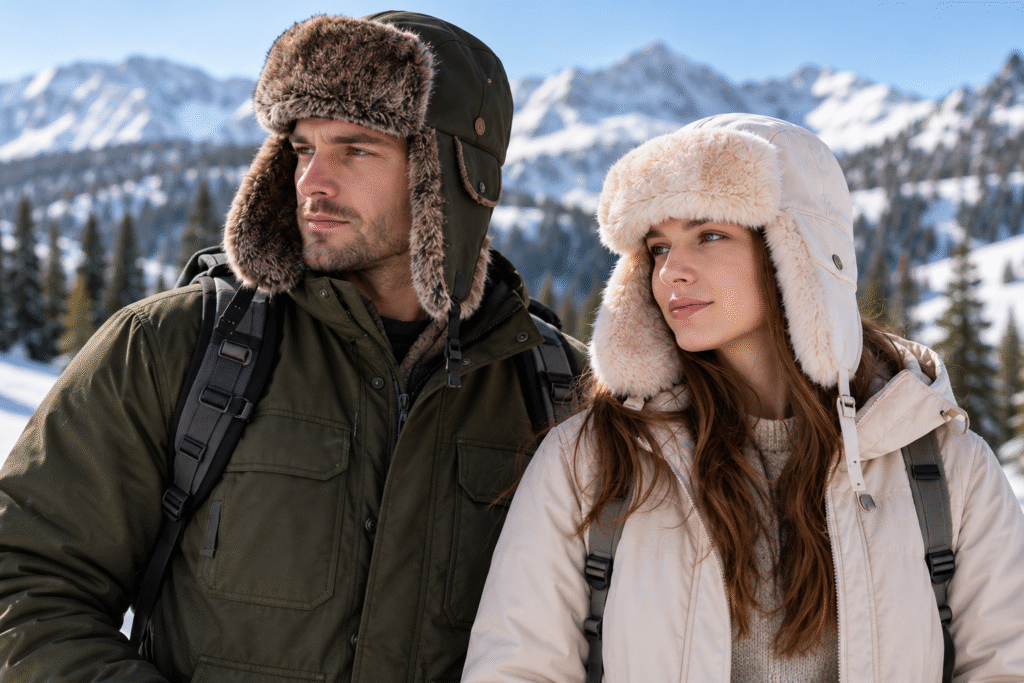
For fashion-oriented brands, custom trapper hats can add a distinctive product category to winter collections.
- Faux fur and sherpa linings create a recognizable winter aesthetic.
- Corduroy, cotton, wool blends, and polyester offer different textures and retail positioning.
- Embroidered logos, woven labels, and custom packaging support brand recognition.
- Coordinated colorways can complement jackets, hoodies, and other seasonal apparel.
For an initial winter collection, SUMKCAPS recommends starting with 1–3 designs and evaluating sample appearance, fit, and material quality before expanding the range.
3. Workwear and Promotional Brands
For workwear and promotional applications, buyers should prioritize durability, practical construction, and consistent branding.
Polyester outer fabrics, fleece linings, reinforced seams, and adjustable fasteners are useful starting points.
For example, a company purchasing 1,000 promotional winter hats should evaluate logo consistency, size distribution, packaging requirements, and delivery schedules before approving mass production.
Key Design Considerations for Custom Trapper Hats
The design of a custom trapper hat affects its appearance, warmth, comfort, manufacturing complexity, and overall cost. Brands should define the construction specifications before requesting a quotation.
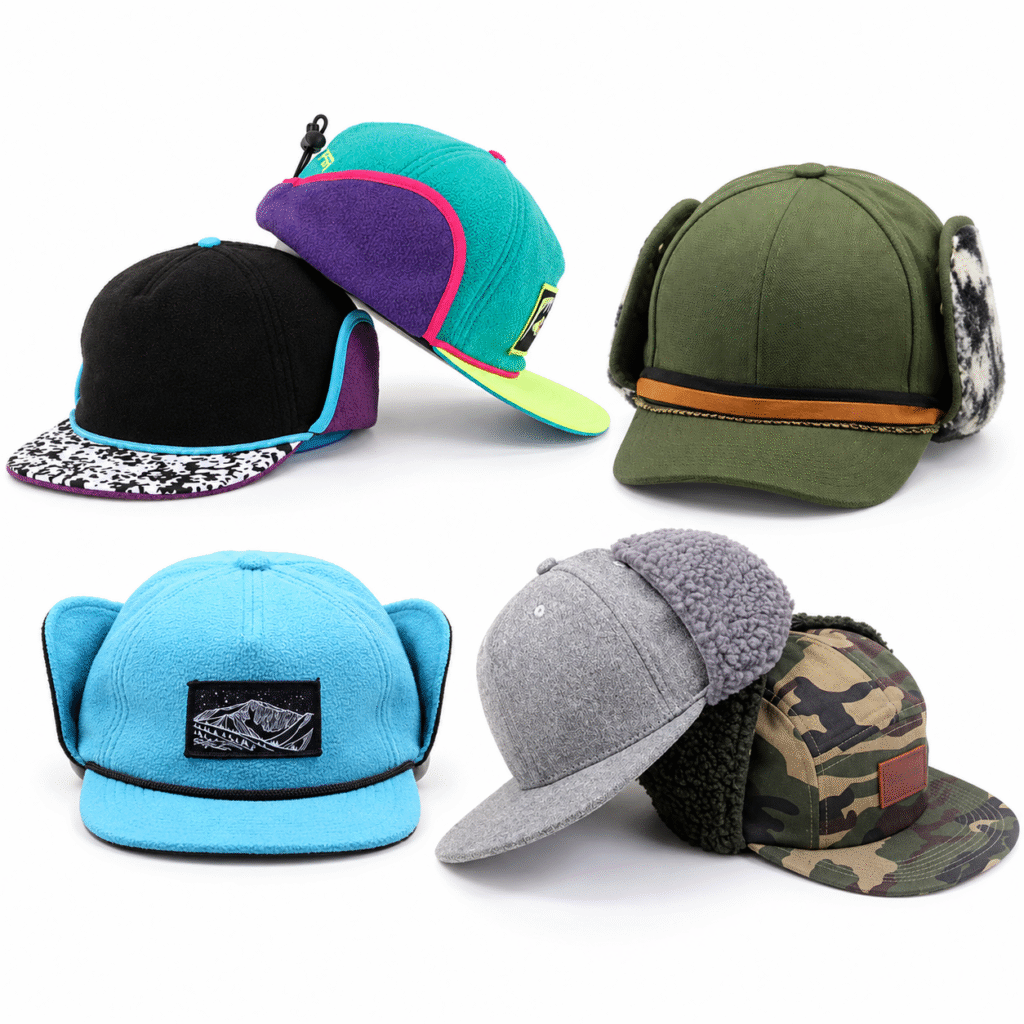
1. Crown Shape, Earflaps, and Visor Construction
Three structural elements deserve particular attention.
Estructura de la corona
- Rounded crowns provide a traditional winter-hat silhouette.
- Structured designs maintain a more defined shape.
- Softer constructions may suit casual and fashion-oriented collections.
Earflap construction
- Longer earflaps provide greater coverage around the ears and lower sides of the head.
- Shorter earflaps create a more compact appearance.
- Fold-up designs offer additional wearing options.
Visor construction
- Short front visors create a compact winter profile.
- Extended visors provide additional shading.
- Reinforced visors help maintain the intended shape.
For product development, brands should specify crown dimensions, visor length, and earflap coverage in centimeters rather than relying only on reference photographs.
For example, a 5 cm visor and a 7 cm visor can create noticeably different silhouettes. These are illustrative design dimensions, not universal trapper-hat standards.
2. Fit, Sizing, and Adjustable Features
Fit is particularly important because trapper hats often contain thick linings and additional insulation.
Brands should consider:
- Head circumference and internal crown dimensions.
- Lining thickness and its effect on fit.
- Adjustable chin straps or buckles.
- Size consistency across production batches.
Adult headwear specifications commonly cover approximately 54–62 cm in head circumference, although the appropriate size range depends on the intended market and product design.
For private label collections, SUMKCAPS recommends confirming the finished internal dimensions after the lining and insulation have been installed.
3. Custom Colors, Patterns, and Branding Details
Color and branding specifications should be finalized during sample development.
Popular options include solid colors, camouflage patterns, contrasting earflaps, and coordinated lining colors.
Brands should also define:
- Logo dimensions and placement.
- Embroidery thread colors.
- Fabric color references.
- Label placement.
- Packaging requirements.
For example, a front embroidery design measuring 6 cm wide may require a different placement or stitch-density adjustment from a 10 cm design, particularly on curved or heavily insulated crown panels.
Best Materials for Custom Trapper Hats
The best materials for custom trapper hats depend on the intended climate, target customer, desired appearance, and budget. No single fabric is ideal for every winter collection.
1. Outer Shell Materials: Nylon, Polyester, Cotton, and Wool
| Material | Main advantages | Consideraciones | Suitable applications |
|---|---|---|---|
| Nylon | Lightweight, abrasion-resistant options | Performance depends on fabric construction and finish | Outdoor and hunting collections |
| Poliéster | Versatile, easy-care, wide color availability | Breathability and wind resistance vary | Workwear and promotional hats |
| Algodón | Soft, natural appearance | Absorbs moisture and may dry slowly | Casual and streetwear collections |
| Wool / Wool Blend | Warm feel and premium appearance | Higher care requirements and variable cost | Premium winter collections |
For example, a brand developing 500 outdoor trapper hats may prioritize a tightly woven polyester shell with a water-repellent finish rather than untreated cotton.
However, a water-repellent fabric does not automatically make the finished hat waterproof. Seam construction, coatings, and product testing also matter.

2. Lining Materials: Fleece, Faux Fur, and Sherpa
The lining affects warmth, comfort, weight, appearance, and perceived retail value.
| Forro | Main characteristics | Recommended use |
|---|---|---|
| Vellón | Soft, relatively lightweight, available in multiple weights | Outdoor and everyday winter hats |
| Piel sintética | Plush appearance, substantial loft | Fashion and cold-weather collections |
| Sherpa | Textured, fleece-like appearance | Lifestyle and winter retail products |
Fleece fabric weights may range from approximately 150 to 300 GSM or more, depending on the material specification.
A 200 GSM fleece and a 300 GSM fleece can feel different in thickness and weight, but GSM alone does not establish which finished hat will be warmer.
At SUMKCAPS, we recommend evaluating lining materials through physical samples rather than selecting solely from fabric photographs.
3. Insulation, Wind Resistance, and Water Resistance
For colder markets, shell and lining materials may need to be combined with additional insulation.
Brands should evaluate:
- Insulation: Synthetic padding can provide additional thermal protection.
- Wind resistance: Tightly woven shells and suitable fabric constructions help limit airflow.
- Water resistance: Appropriate finishes help reduce moisture penetration.
- Breathability: The finished construction should balance warmth with moisture management.
For example, two hats using the same polyester shell may perform differently if one includes 80 GSM synthetic insulation and the other has no additional padding.
These insulation weights are design examples, not verified temperature ratings. Finished-product testing is necessary before making specific performance claims.
4. Choosing Materials for Different Target Markets
For hunting and outdoor collections, prioritize durable shells, practical earflaps, and comfortable linings.
For streetwear collections, prioritize texture, silhouette, color, and branding flexibility.
For workwear, focus on durable construction, repeatable specifications, and easy-care materials.
For premium winter retail, wool blends, faux fur, and carefully developed finishing details may justify a higher product positioning.
Brands can also explore our trapper hat wholesale collection to review different construction and material options.
Customization Options for Private Label Trapper Hats
Private label trapper hats allow brands to control product appearance, labeling, packaging, and customer positioning.
At SUMKCAPS, customization can include fabric selection, logo applications, construction details, and branded accessories.
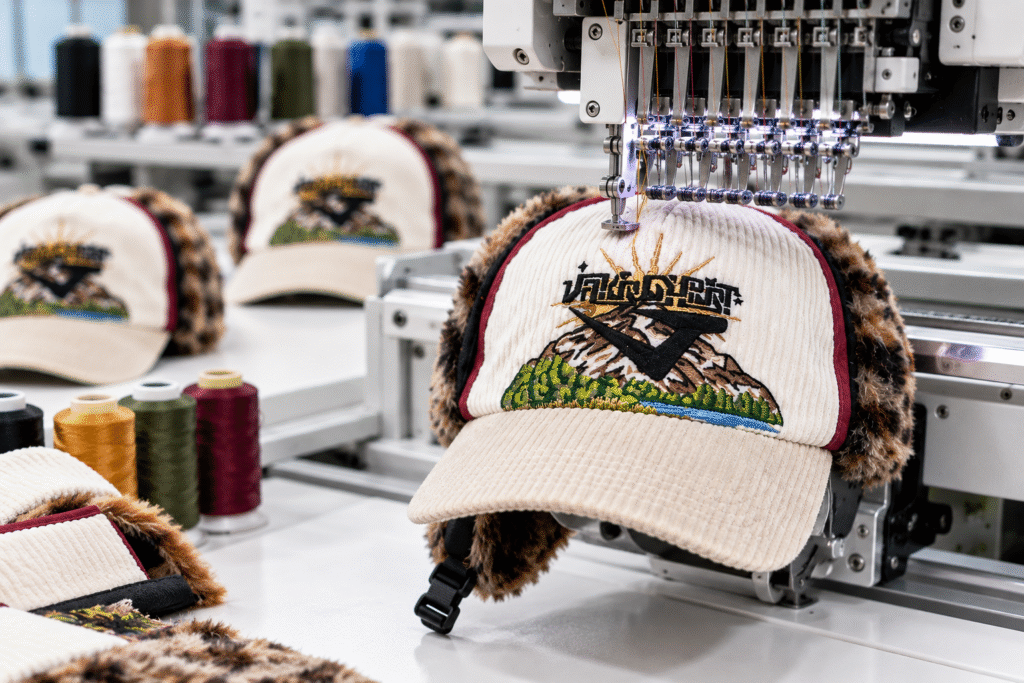
1. Logo Customization: Embroidery, Patches, and Printing
The most appropriate logo method depends on the design complexity, material, and available decoration area.
- Flat embroidery: Suitable for text, symbols, and detailed brand logos.
- 3D puff embroidery: Creates raised lettering and bold graphic effects where the fabric structure supports it.
- Woven patches: Useful for fine details and multicolor designs.
- Leather patches: Offer a distinctive outdoor or heritage appearance.
- PVC and rubber patches: Provide dimensional branding with a durable surface.
- Printing: Suitable for certain fabric panels and graphic designs.
For example, a 7 cm-wide embroidered logo may be suitable for a relatively smooth crown panel, while a small woven patch may work better on heavily textured material.
Logo placement and construction should always be verified during sampling.
2. Private Labeling and Custom Packaging
Brands can develop a consistent retail presentation through:
- Custom woven brand labels.
- Care and composition labels.
- Hang tags.
- Size labels.
- Branded packaging.
- Product stickers and carton markings.
For an order of 1,000 pieces, packaging specifications should be established before mass production to prevent inconsistencies between individual products and shipping cartons.
Care labels should also reflect the actual fiber composition and applicable destination-market requirements.
3. OEM vs. ODM Trapper Hat Manufacturing
OEM and ODM services support different product development needs.
| Factor | Fabricación OEM | ODM Manufacturing |
|---|---|---|
| Product concept | Primarily buyer-provided | Developed with manufacturer support |
| Design ownership | Defined by agreement | Defined by agreement |
| Development involvement | Based on supplied specifications | More manufacturer design support |
| Más adecuado para | Established brands | Brands needing product development assistance |
| Muestreo | Required for confirmation | Required for development and confirmation |
For brands with completed technical drawings, OEM production may provide greater control over specific design requirements.
For brands starting with reference images or general concepts, ODM development can help translate those ideas into manufacturable products.
SUMKCAPS supports both OEM and ODM development for custom headwear orders.
How Much Do Custom Trapper Hats Cost in Bulk?
The cost of custom trapper hats depends on order quantity, materials, construction, insulation, decoration, packaging, and delivery terms. Buyers should compare quotations based on identical specifications rather than selecting the lowest advertised unit price.
1. Key Factors That Affect Custom Trapper Hat Pricing
The main cost drivers include:
- Outer shell fabric type and quality.
- Lining and insulation specifications.
- Earflap and visor construction.
- Embroidery size and stitch count.
- Patch material and application method.
- Custom labels and packaging.
- Order quantity and production complexity.
For example, a design with 300 GSM sherpa lining, synthetic insulation, and multiple embroidered details will generally have a different cost structure from a simple polyester-and-fleece construction.
2. How Order Quantity Affects Unit Pricing
Larger production runs can distribute certain fixed setup and development costs across more units.
At SUMKCAPS, the standard MOQ is 200 pieces per color per design.
Por ejemplo:
| Order structure | Total quantity | MOQ assessment |
|---|---|---|
| 1 design × 1 color × 200 pcs | 200 | Meets standard MOQ |
| 1 design × 2 colors × 200 pcs | 400 | Meets standard MOQ |
| 2 designs × 2 colors × 200 pcs | 800 | Meets standard MOQ |
| 1 design × 2 colors × 100 pcs | 200 | Below standard per-color MOQ |
Actual pricing should be calculated after confirming materials, artwork, construction, and order distribution.
3. How to Compare Supplier Quotations
A useful quotation comparison should include more than the product unit price.
Buyers should confirm:
- Exact material and lining specifications.
- Logo decoration and labeling costs.
- Sample development fees.
- Packaging requirements.
- Incoterms and freight responsibilities.
- Payment terms.
- Production and delivery schedules.
- Quality standards and defect-resolution procedures.
For example, a quotation based on EXW terms cannot be directly compared with a DDP quotation without accounting for transportation, import charges, and other applicable costs.
How to Choose a Reliable Custom Trapper Hat Manufacturer
A reliable custom trapper hat manufacturer should demonstrate product development capability, consistent quality control, transparent MOQ requirements, and realistic delivery commitments.
Brands should evaluate suppliers using measurable criteria before approving bulk production.
1. Manufacturing Experience and Production Capabilities
A manufacturer should be able to explain how it handles pattern development, fabric sourcing, cutting, sewing, lining installation, embroidery, inspection, and packaging.
SUMKCAPS operates a production facility of approximately 6,000 square meters with more than 120 skilled workers and an annual headwear production capacity exceeding 2.6 million units.
These figures describe overall headwear manufacturing capabilities, not a guaranteed trapper-hat-specific production capacity.
Brands should request relevant product samples and confirm the available capacity for their specific designs.
2. Minimum Order Quantity and Production Flexibility
Before placing an order, buyers should confirm whether MOQ applies per design, color, or size.
SUMKCAPS offers a standard MOQ of 200 pieces per color per design, making it possible for brands to begin with a limited collection before scaling production.
For example, a new winter apparel brand could start with 400 hats across two colors, evaluate retail performance, and then plan a larger reorder.
3. Sampling and Pre-Production Approval
Samples should be used to verify the final product specifications before mass production.
SUMKCAPS typically requires approximately 7–9 working days for sampling, depending on the design and material requirements. The sample fee is US$50 per piece, with an additional US$35 shipping fee.
During sample approval, buyers should check:
- Crown shape and finished measurements.
- Earflap length and symmetry.
- Lining quality and insulation placement.
- Embroidery or patch appearance.
- Fastener functionality.
- Label and packaging details.
A signed or otherwise formally approved pre-production sample provides an important reference for subsequent quality inspections.
4. Quality Control and Product Consistency
Quality control should cover incoming materials, in-process production, and finished goods.
For custom trapper hats, important inspection points include:
- Fabric defects and color consistency.
- Stitching strength and seam alignment.
- Earflap symmetry.
- Lining attachment.
- Logo position and appearance.
- Size tolerance.
- Packaging accuracy.
Buyers may specify an AQL-based inspection plan, such as General Inspection Level II with agreed defect acceptance criteria, when appropriate.
The exact inspection level and acceptable defect limits should be documented in the purchase agreement rather than assumed.
5. Production Lead Times and International Shipping
Production planning is particularly important for seasonal winter products.
SUMKCAPS’ typical timelines are:
| Production stage | Typical time |
|---|---|
| Desarrollo de muestras | 7-9 días laborables |
| Bulk production (under 5,000 pcs) | 25–35 working days |
| Bulk production (over 5,000 pcs) | Approximately 35–45 working days |
| DHL / FedEx / UPS shipping | Approximately 4–8 days |
| DDP shipping service | Approximately 15–25 days |
These are indicative timelines, not guaranteed delivery commitments. Order complexity, material availability, shipping routes, customs procedures, and destination requirements may affect the final schedule.
Brands should also allow time for sample revisions and approval before confirming retail launch dates.
Common Mistakes to Avoid When Sourcing Custom Trapper Hats
Avoiding common procurement mistakes can reduce rework, quality disputes, and missed delivery deadlines.
1. Selecting Materials Based Only on Appearance
A thick faux fur lining may look warm, but appearance alone does not establish thermal performance.
Brands should evaluate the complete shell, lining, insulation, and fit combination for their intended market.
For example, an outdoor product designed for temperatures around −10°C should not be advertised as suitable for that condition without appropriate product-level performance evidence.
2. Approving Samples Without Checking Fit
Lining thickness can change the finished internal dimensions of a hat.
A 58 cm target head circumference does not guarantee the intended fit unless the finished product is measured and tested.
Buyers should approve both the external appearance and internal fit.
3. Comparing Prices Without Matching Specifications
Two quotations may differ because one includes additional insulation, premium lining, or more complex branding.
For a 1,000-piece order, even a $0.50 difference in unit cost represents $500 in total product cost.
However, price comparisons are meaningful only when specifications and trade terms are equivalent.
4. Misunderstanding MOQ Requirements
An advertised MOQ of 200 pieces does not necessarily mean buyers can combine unlimited colors and designs.
At SUMKCAPS, the standard requirement is 200 pieces per color per design.
Brands should confirm order distribution before finalizing their purchasing plans.
5. Underestimating Seasonal Production Timelines
Winter products must arrive before their intended selling season.
For example, a brand targeting an October retail launch should account for sampling, production, freight, customs clearance, and domestic distribution well in advance.
A practical purchasing schedule should include contingency time for revisions and logistics disruptions.
Custom Trapper Hats Wholesale and Manufacturing at SUMKCAPS
En SUMKCAPS, we support apparel brands, outdoor brands, hunting gear companies, wholesalers, and distributors with OEM and ODM headwear manufacturing.
Nuestra sombreros de trampero personalizados services cover product design development, fabric selection, lining materials, embroidery, patches, private labeling, and packaging customization.
With a standard MOQ of 200 pieces per color per design, we support brands developing initial winter collections as well as buyers planning larger wholesale orders.
Our manufacturing operations include approximately 6,000 square meters of production space, more than 120 skilled workers, and an annual headwear production capacity exceeding 2.6 million units. We also have over 10 years of international trade and export experience, serving customers across Europe, North and South America, Oceania, and Asia.
For brands reviewing available styles, our trapper hat wholesale collection provides product references for custom development.
Request a Custom Trapper Hat Quote
Share your design references, estimated quantity, preferred materials, logo artwork, and delivery destination with SUMKCAPS. Our team can review the requirements and provide guidance on sampling, production feasibility, and quotation details.
Conclusión
Custom trapper hats can be a valuable addition to winter apparel, outdoor, hunting, and private label collections when their design and manufacturing specifications match the target market.
Brands should prioritize appropriate shell and lining materials, comfortable earflap construction, suitable branding methods, consistent quality control, and realistic production planning.
At SUMKCAPS, we recommend confirming product specifications through physical samples before committing to bulk production. With OEM and ODM customization, a standard 200-piece MOQ per color per design, and established headwear manufacturing capabilities, we help brands develop custom winter headwear that meets their commercial and product requirements.
FAQ About Custom Trapper Hats
A: Yes. SUMKCAPS offers logo customization through embroidery, woven patches, leather patches, PVC patches, and other suitable methods.
A: Choose OEM when you have established product specifications. ODM is more suitable when you need manufacturer support with design and product development.
A: SUMKCAPS offers OEM and ODM trapper hat manufacturing with a standard MOQ of 200 pieces per color per design.
A: SUMKCAPS requires a minimum of 200 pieces per color per design for custom trapper hat orders.
A: Bulk pricing depends on materials, insulation, logo methods, order quantity, and packaging. Contact SUMKCAPS for a quotation.
A: Fleece offers lightweight comfort, while faux fur provides a plush appearance and insulation potential. Choose based on your target market.


